These are my thoughts based on this break down. When I reference certain shots, you can find that context there.
Casablanca's Opening Montage Is More Than a Map
The animated map sequence. A staple of throwback adventure films. Because this has become a bit of a cliché it's easy for your eyes to glaze over and let the voiceover do the work... people are fleeing France, the journey is long and winding... Got it. Moving on. But slowing down and actually looking at this, I realized how much effective storytelling can happen inside what looks like pure visual shorthand.
Here's a video that highlights the map sequences across the first four Indiana Jones films, probably what most people are picturing when they think of this trope:
These sequences are exciting and fun. I love them. But the pacing goal is fairly narrow: inspire awe, get you pumped for the next leg of the adventure. Some shots show vehicles, some show characters studying maps or clues, but there isn't much of a progression beyond the line itself moving. Which is partly why they can feel like a stylized throwback more than a storytelling tool. They're getting you *around* the map in a cool way, we are not just crossfading to the next location, but it's not elaborating on anything the line isn't already telling you.
Casablanca does something different with the same device.
A Subtle Upgrade
The opening checks the expected boxes at first. A globe spins and settles on France. The familiar map animation kicks in. A line begins to draw itself from Paris toward Casablanca. It has the look of every other "getting there" montage.
And then something different happens: real people appear.
Not stock footage of a plane. Not a stylized graphic. Actual newsreel footage — archival documentary material of real people caught mid-journey. Yes this is a fictional story, but there really are people going through situations like this. I think this is an important component for a war time film.
Also worth noting before going further: older movies get a reputation for being slow. Here, across the montage, I counted 16 different shots. The whole opening, not just this montage, really hits the ground running.
The Footage Follows the Line
Also worth highlighting, the newsreel footage isn't random. It changes based on what's happening geographically. When the line crosses land, we start with people on foot leaving Paris (I assume it's Paris). When it crosses water, we see boats. When the line hits land again, we're back to people moving with some alterations.
Most modern takes on this trope just cut to a plane crossing an ocean. The mode of travel is often the focus. Here, the footage is showing that same information (HOW we get from point A to point B) but also a certain feeling that accompanies it. A scale at which this is happening. And all of this is setting up what's around the corner in the story.
The early land footage is not just a few people. It's crowds. Wide shots full of people walking, a closer shot that brings in children. If you're paying attention, it paints a picture of just how many people are trying to get out. And seeing them mostly on foot makes clear what kind of journey this is. These aren't tourists. These aren't vacationers. These are desperate people.
Arriving Is Not Relief
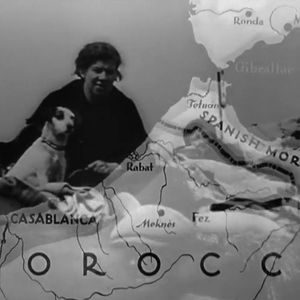 When the line hits land again, the footage doesn't relax. People are still moving — on foot, on carts, on bikes. If anything, this section
makes the desperation more specific. One shot stands out: a single shot (shot 15 in my breakdown)
of a woman and dog sitting on a cart. It's a small, moment inside all the wide crowd shots. It almost feels like a picture from an old LIFE
magazine cover. It doesn't feel triumphant. It feels like this is all they have left.
When the line hits land again, the footage doesn't relax. People are still moving — on foot, on carts, on bikes. If anything, this section
makes the desperation more specific. One shot stands out: a single shot (shot 15 in my breakdown)
of a woman and dog sitting on a cart. It's a small, moment inside all the wide crowd shots. It almost feels like a picture from an old LIFE
magazine cover. It doesn't feel triumphant. It feels like this is all they have left.
That's the note the sequence ends on. Not arrival as relief. The line stops at CASABLANCA, the footage fades, and we sit on the map. But a tone is set. As we move from here into more studio based "movieland" shots, that feeling of real people can linger, even subconsciously going forward.
What a Plane Can't Do
I think it's fun to look at what this trope is capable of. Sure it can be a stylish transition from one location to another, nothing wrong with that. But *Casablanca* uses it as both a location setup, a prologue, and a tone setter all in this stylized opening.